
In this post, I’ll share three powerful ways physicians can invest in real estate—ranging from hands-on rentals to fully passive syndications.

This post may contain affiliate links.
I still remember the first time real estate income hit my bank account.
It was just a couple of years after finishing residency, and I was still running on the hamster wheel of hospital shifts, post-call brain fog, and student loan payments that felt like a second mortgage. Then one day, I checked my bank account and there it was: a rent payment from my very first property.
I sat there at my kitchen table looking at my laptop, and for the first time, I felt something crack open in my brain: What if I didn’t always have to trade time for money?
That was the moment I realized real estate wasn’t just some side hustle. It could be a legitimate, life-changing tool for financial freedom.
In this post, I’ll break down three powerful ways physicians can invest in real estate, ranging from the hands-on to the hands-off. Whether you’re looking to build sweat equity through renovations or you just want mailbox money without the headaches, there’s a path for you.
Why Real Estate Matters for Physicians
Physicians are in a weird financial situation. On paper, we earn “high incomes.” But in reality, many of us are starting our careers 10–15 years behind our peers. After college, med school, residency, and possibly fellowship, we’re often in our mid-30s with:
- Six figures of student loans.
- A lifestyle expectation (hello, doctor car and house).
- And jobs that demand not only our time but our emotional and physical energy.

The truth? Burnout is real, and the “doctor’s income” isn’t always the golden ticket it’s cracked up to be. That’s why diversifying income streams is more than a luxury—it’s survival.
Real estate offers a way to create financial buffers, reduce reliance on clinical work, and reclaim your time. Let’s explore three main approaches.
1. Active Real Estate Investing: Sweat, Stress, and Big Rewards
Active investing often starts with a straightforward purchase: a single-family rental home. The basic formula is simple—buy a property, make necessary improvements, and then rent it out.
On paper, that kind of deal can generate strong cash flow and build long-term equity. But here’s the catch: active investing is not “passive” in any sense of the word. It often means juggling contractors, keeping tabs on renovation timelines, and handling tenant issues.
That’s why active investing can be both rewarding and exhausting. For physicians who enjoy hands-on projects and have the bandwidth to manage them, it’s a powerful way to build wealth. For those already stretched thin, though, it will feel like taking on a second job. That’s how I felt just a few years ago, before I increasingly decided to focus on more passive forms of investing (more below).
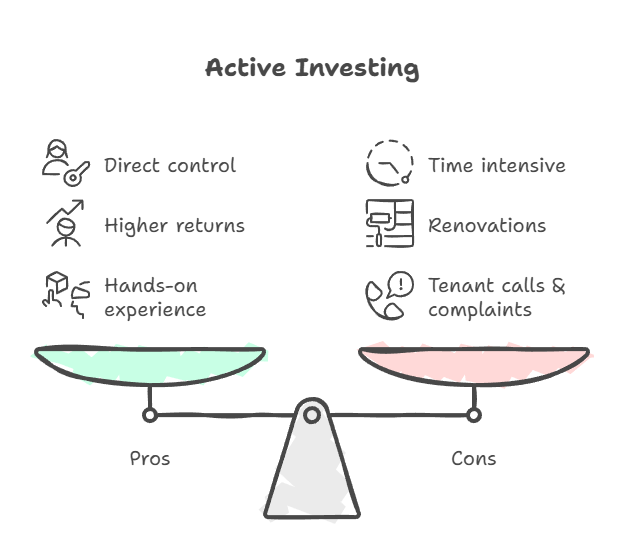
Pros of Active Investing:
- Direct control over the property.
- Higher potential returns.
- Valuable hands-on education.
Cons of Active Investing:
- Time intensive (time that most physicians don’t have).
- Tenant phone calls at 2 a.m. (yes, it happens, especially with short term rentals).
- Renovation stress (HGTV makes it look much easier than it is).
For physicians who enjoy the process, active investing can be both financially and personally rewarding. But if the idea of arguing with contractors gives you hives, there’s another way.
2. Passive Real Estate Investing: Mailbox Money Without the Headaches
For most busy doctors, the appeal of passive real estate investing is obvious: you get the financial benefits without the operational burden.
The most common form is through real estate syndications. This is where a group of investors pool their money to buy a large property—like an apartment complex—and a professional team manages the deal.
As you compare passive opportunities, understanding how to evaluate cap rates and whether local or long-distance investing fits your goals can help frame the decision.
Pros of Passive Investing:
- Minimal time commitment.
- Diversification across bigger, more lucrative deals.
- Professional management.
Cons of Passive Investing:
- Less control—you’re trusting the operators.
- Illiquid—your money is often tied up for 3–7 years.

This is one reason I started Cereus Real Estate. I wanted to give physicians and busy professionals access to high-quality, vetted syndication opportunities so they could build wealth without adding another job to their plate. If you’ve ever thought, I’d love to invest in real estate but I don’t have the time, this could be your answer.
3. Building a Real Estate Investment Company: Scaling for the Long Game
Once you’ve dipped your toes into real estate, there’s another level: building your own real estate investment company.
This is what I did when I founded Cereus Real Estate. Instead of just managing my own portfolio, I wanted to create a platform that allowed others to invest alongside me.
Running a real estate company isn’t unlike running a medical practice. You need:
- Systems.
- Leadership.
- The ability to handle risk and make tough decisions.
But the payoff is incredible. Not only do I get to grow my own investments, I also get to help other physicians and professionals take their first steps toward financial independence. It’s a ripple effect: one investment at a time, one investor at a time, changing the trajectory of families and futures.
After working on Cereus for about two years now, I can definitely say that it isn’t a low commitment endeavor. Despite scaling my medical practice back to quarter-time via locum tenens, I absolutely still feel stretched with the various demands of growing and running a new business. It’s absolutely rewarding, but there’s a huge time and energy commitment involved with a new business.
Bonus Options: REITs and Crowdfunding
If you want an even more hands-off approach, there are other tools worth considering:
- REITs (Real Estate Investment Trusts): Basically real estate stocks. Easy to buy, easy to sell, but usually lower returns.
- Crowdfunding platforms: Online marketplaces where you can invest small amounts into real estate deals. Lower barrier to entry, but due diligence is critical.
These can be great starting points if you’re brand new to real estate and just want to dip your toe in before committing larger sums.
The Versatility (and Beauty) of Real Estate
What I love most about real estate is its versatility. Whether you want to roll up your sleeves and swing a hammer, or you just want to write a check and collect dividends, there’s a strategy for you.
It’s not one-size-fits-all. It’s about matching the approach to your goals, your risk tolerance, and—let’s be honest—your available time.
Reflection: Why This Matters
Real estate has completely changed my financial outlook. More importantly, it’s given me something medicine alone could never offer: freedom.
Freedom to step back when burnout creeps in.
Freedom to spend more time with family.
Freedom to imagine a life where financial decisions aren’t dictated by the next hospital shift.
If you’re a physician considering real estate, my advice is simple: start. Don’t let the learning curve or fear of the unknown paralyze you. Attend a seminar, join a meetup, talk to someone who’s already doing it. The first step doesn’t have to be huge—it just has to be intentional.
Because here’s the truth: your financial future won’t change until you decide to change it.
Financial freedom isn’t a dream, it’s a decision. Let’s get there together.

Experience the financial benefits of real estate without dealing with the headache!

Want to support the blog?
- Join our investor club at Cereus Real Estate
- Visit my Recommendations page
- Check out my wife’s food blog: Eat Dessert First
- Check out my TikTok channel
- Follow me on Instagram
- Follow me on YouTube
- Contact me with questions