In the first two articles in this series, I explored why artificial intelligence feels different from previous technological advances and how it’s already beginning to change the way medicine is practiced. Those changes are still unfolding, and no one can say with certainty what the profession will look like ten or twenty years from now, except that it will likely be quite different.
That uncertainty naturally leads to another question:
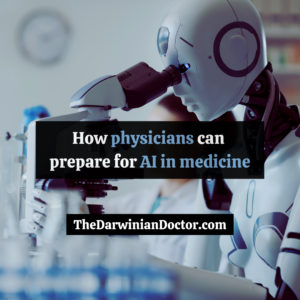
If there’s even a reasonable chance that AI will reshape a meaningful portion of what physicians do, how should we prepare?
I don’t think the answer is fear and I don’t think it’s denial, either.
It’s actually curiosity.
Learn the Tools Before You Judge Them
One of the biggest mistakes we can make is forming strong opinions about AI without ever using it.
Over the past few years, I’ve made a conscious effort to incorporate AI into my daily workflow. I use it to help summarize research, organize information, brainstorm ideas, review writing and answer questions that would have taken far longer to investigate on my own. It’s become part of how I think through problems rather than simply another piece of software sitting on my computer.
Since coding agents became actually useful earlier this year, I’ve also immersed myself in the tools. I’ve used them to successfully consolidate a myriad of businesses and interests under one unified dashboard, complete with an ever-growing list of automations and time savers.
This doesn’t mean AI is always the right tool, or that it’s even right at all. Like any tool, it has strengths and limitations. But learning those limitations requires actual experience rather than assumptions.
Many physicians are understandably skeptical. Medicine rewards careful thinking, and we should be cautious whenever a new technology promises dramatic change. But caution and curiosity aren’t opposites. In fact, they’re often strongest when they exist together.
Whether AI ultimately transforms medicine as quickly as I predict or progresses more gradually, physicians who understand these tools will almost certainly be better positioned than those who ignore them altogether.
Optionality Has Always Been Valuable
As I’ve thought about where medicine may be heading, I’ve found myself returning to a lesson that has shaped many of my decisions over the past decade:
Build options.
More than ten years ago, I became fascinated by investing, particularly real estate. At the time, I wasn’t trying to escape medicine. I loved operating, caring for patients and building my career as a urologist. Investing was simply another area that challenged me intellectually and gave me an opportunity to grow.
Over time, those investments became something much larger. What started as buying rental properties eventually evolved into building a real estate business and, later, launching Cereus Real Estate, where we help physicians invest passively into institutional quality real estate.
Looking back, I don’t think the most valuable thing I built was a portfolio, but optionality itself.
Having another source of income, another set of skills and another professional identity changes the way you experience uncertainty. It doesn’t eliminate risk, but it gives you more flexibility when the world changes around you. That lesson feels especially relevant today.

You Don’t Have to Follow My Path
Real estate isn’t the only answer. It may not even be the right answer for you.
Long before any of us wore a white coat, we had interests that made us stand out. Maybe you enjoyed programming, writing, teaching, engineering, design, investing, business, or building things. Those interests didn’t disappear when you entered medicine. They were simply pushed into the background while your medical training demanded nearly all of your attention.
This may be a good time to revisit them. After all, developing skills outside of medicine has always been worthwhile.
Some of those interests may remain hobbies. Others could become businesses, investments, consulting opportunities, or entirely new career paths that exist alongside clinical practice. The point isn’t to abandon medicine, but to recognize that you are capable of contributing in far more ways than the traditional career path sometimes suggests.
Start Before You Feel Ready
One of the easiest mistakes is believing that preparation requires a dramatic change, but it usually doesn’t. Learning how to use AI effectively can begin with a single question each day to a chatbot, for example.
Similarly, investing can begin with reading a book, listening to a podcast, or buying your first index fund. If real estate interests you, spend time understanding the fundamentals before worrying about your first property. If entrepreneurship excites you, start exploring ideas long before you feel qualified to launch a company. Small steps have a way of compounding.
The hardest part is rarely the work itself, but deciding that the future is worth preparing for.

The Profession Will Change. So Can We.
Every generation of physicians practices a different version of medicine.
Our predecessors adapted to antibiotics, advanced imaging, laparoscopic surgery, robotic surgery and the digital transformation of healthcare. None of those changes eliminated the need for physicians, but each required doctors to learn, evolve, and redefine parts of their profession.
Artificial intelligence will likely ask the same of us. Exactly how much will change remains uncertain. What doesn’t feel uncertain is that standing still has rarely been the best strategy during periods of technological change.
Medicine has always rewarded lifelong learners. Perhaps that’s the most reassuring thought of all. The habits that make someone a good physician — curiosity, humility, critical thinking, and a willingness to keep learning — are the very same qualities that will help us navigate whatever comes next.
We don’t need to predict the future perfectly. We simply need to be ready to grow alongside it.
And if, along the way, we build lives with a little more flexibility, a few more options, and greater financial independence, we’ll be better prepared no matter what the future of medicine looks like.
Financial freedom isn’t a dream, it’s a decision. Let’s get there together.

Want to support the blog?
- Join our investor club at Cereus Real Estate
- Visit my Recommendations page
- Check out my wife’s food blog: Eat Dessert First
- Check out my TikTok channel
- Follow me on Instagram
- Follow me on YouTube
- Contact me with questions
Experience the financial benefits of real estate without dealing with the headache!