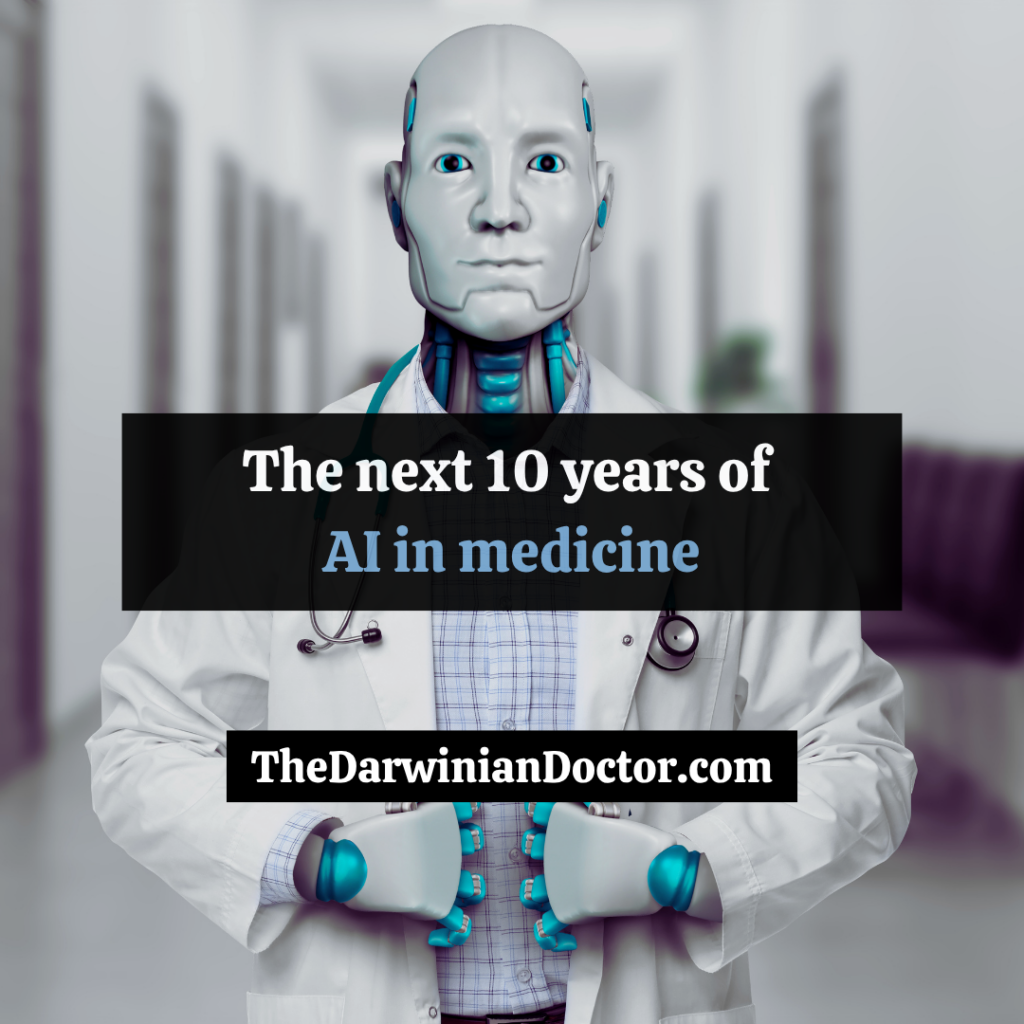
In the first part of this series, I wrote about something that has been occupying more of my attention lately than I expected: not artificial intelligence itself, but the pace at which it’s improving. Medicine has adapted to extraordinary technological advances before, yet those changes usually unfolded over decades. Medical schools had time to adjust their curricula. Residency programs evolved gradually. Hospitals adopted new technologies one careful step at a time.
Artificial intelligence feels different.
It’s not the first technology capable of changing medicine, but the timeline appears compressed in a way that I’m not sure our institutions are accustomed to handling.
I hope I’m wrong about that, and our medical institutions surprise me with their ability to adapt. We will find out soon enough.
Whether or not our medical institutions are able to adapt, we will continue to see swift progress when it comes to AI’s effect on medicine. It’s happening, whether we like it or not.
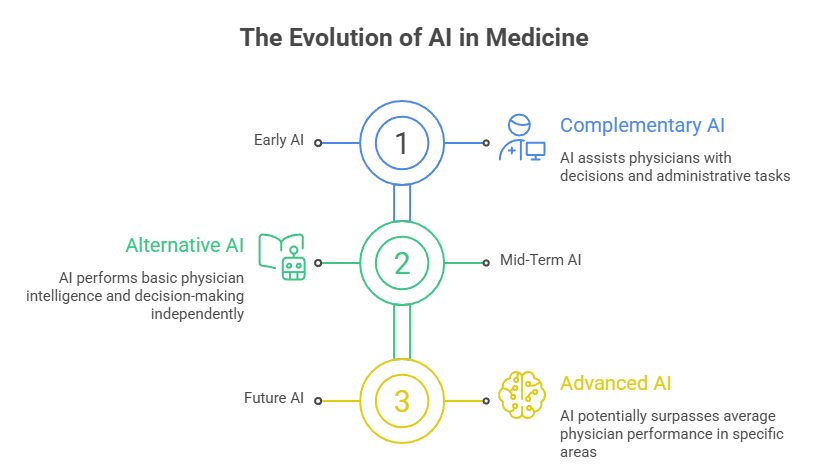
I generally see this taking place in two stages over the next 10 years:
- The Age of Complementary AI in Medicine
- The Age of Alternative AI in Medicine
Below, I’m going to explain what I mean by this, as well as outline the general timeline that we could reasonably expect for this all to take place.
The Changes Are Already Here
When people talk about AI in healthcare, the conversation often jumps straight to a future where computers diagnose patients independently or replace physicians altogether. Think about the robotic med-pods that have appeared in movies like Elysium (2013) or Prometheus (2012).
Those are fun thought experiments, but they can distract from what’s actually happening in clinics today.
The physicians I know who use AI aren’t asking it to replace their clinical or surgical judgment. They’re using it to cross reference new research, organize information more efficiently, draft patient education materials, or help reduce the endless documentation that has literally become the majority of modern medicine.
In many ways, AI has entered medicine through the side door. It has found the parts of our work that almost nobody enjoys doing:
- Documentation
- Searching through research papers to answer a specific clinical question
- Cross-checking allergies and medication interactions
- Writing (or fighting) prior authorizations
- Summarizing lengthy patient visits into an organized note
Documentation isn’t the reason why most of us went into medicine, yet it consumes an astonishing amount of time. If a tool can reduce that burden without compromising patient care, physicians are generally willing to give it a chance, and that shouldn’t surprise us.
From the perspective of the AI companies, this makes total sense. The name of the game is widespread adoption as soon as possible, and that means focusing on the types of AI that address real pain points and bottlenecks that currently torture physicians worldwide.

I’m not surprised that AI in medicine is already popular.
Medicine has never resisted technology simply because it’s new. We adopted laparoscopic surgery because it improved recovery and pain. Robotic surgery became part of many operating rooms because it expanded what surgeons could accomplish, especially in pelvic surgery. Point-of-care ultrasound, advanced imaging, electronic prescribing, minimally invasive procedures: medicine has always incorporated tools that help us care for patients more effectively.
Artificial intelligence is the next big step in that progression.
When AI Stops Being Just an Assistant
The current crop of artificial intelligence tools in medicine all play supportive roles. AI summarizes charts, drafts notes, organizes medical literature, and helps physicians work more efficiently. In radiology and pathology, it might suggest abnormalities as well.
That’s the phase we’re in today, and it’s easy to imagine this phase simply continuing in a way that benefits physicians, as opposed to harming physicians.
Some notable (albeit biased) tech execs have argued that AI in medicine will actually increase the demand for physician services.
As NVIDIA CEO Jensen Huang said on the Lex Friedman Podcast:
Every radiology platform and package today is driven by AI, and yet the number of radiologists grew.
When you dig into the numbers, this isn’t quite true as stated. The number of radiologists did grow about 17.3% from 2014 to 2023. But according to recent data from the world of neuroradiology, where 81% of platforms integrate AI, the radiologists felt that there was “minimal perceived impact on workload, and performance was viewed as variable.”
This all begs the question if physician demand is increasing despite AI, instead of as a result of AI itself.
Regardless, it’s clear to me that we are currently in the Age of Complementary AI in Medicine.
The Age of Complementary AI in Medicine
Currently, AI in medicine can be labelled collectively as tools that make physicians more productive without changing the fundamental relationship between doctor and patient. In its current form, AI allows us to spend more time doing the parts of medicine that require human judgment.
Instead of competing for physician services, AI is taking care of a lot of the stuff we don’t like to do. It’s complementary to our principal role as healers and diagnosticians.
After all of those reports about physician burnout over the past decade, hospital systems are eager to find ways to reduce administrative burden on physicians. The fact that reducing administrative burden makes physicians more efficient is an added bonus, since increased efficiency means increased revenue.
From personal use, I can tell you that I’m happy to utilize AI to save time and typing. If AI can act as my scribe and help me look up the most recent data on obscure conditions, great!
There’s a reason that more than half of physicians report using the tool OpenEvidence, for example. It’s convenient, accurate, very useful, and nonthreatening.
Over the next 3-5 years, I see this trend continuing, until AI is woven into every software layer of physician life.
Because AI helps reduce the painful parts of our job, I predict that physicians will continue to welcome this phase of AI with open arms.
The second stage of AI in medicine will be far more disruptive.
The Age of Alternative AI in Medicine
The problem with AI is that its capabilities will not stop at the complementary level. The same training and advancement that is pushing AI towards superintelligence will open the door to the next phase of AI in medicine: Alternative AI.
What do I mean by this?
Eventually, AI systems won’t simply help physicians make decisions and reduce administrative burden. They’ll become credible alternatives for basic physician intelligence and decision-making itself.
That doesn’t mean replacing every physician or every specialty. Medicine is far too complex for sweeping predictions like that. But it does mean there will almost certainly be specific tasks, and perhaps entire areas of practice, where AI consistently performs as well as, or better than, the average physician.
We’ve already seen versions of this story play out in other industries. At first, technology makes professionals more efficient. Then, almost without noticing, it becomes capable of doing parts of the job independently. (Think robotics in car manufacturing, for example.)
The distinction matters because those are very different futures:
- One changes how physicians work.
- The other begins changing what physicians do.
Doctors are Experts at Pattern Recognition (and so is AI)
It shouldn’t be so hard to imagine that AI can replace the diagnostic capability of physicians.
Medicine is built around pattern recognition. Much of medical school, for example, is learning the basic knowledge necessary to spot the patterns and aberrations inherent to illness. Residency training translates this basic knowledge into actual diagnostic skills through mentoring and endless hours of practice.
These skills are hard won over many years. But diagnostic skills are exactly the kind of thing that modern AI systems have become increasingly good at doing.
In late 2024, a team demonstrated that OpenAI’s GPT-4 system alone outperformed physicians’ diagnostic reasoning by about 16%. As of the writing of this post, we are almost a year past that published result, and many generations of improved LLM capability as well.
This follows two studies that pitted OpenAI’s models against the MCAT, which is the national medical school entry exam. In 2023, GPT 3.5 scored around the median percentile (approximately 55-60th percentiles). Just two years later in 2025, GPT 4.5 scored in the 99th percentile on the MCAT. Standardized testing is not the same as real patients, but for anyone who knows how hard these exams are, the progression is remarkable.
That doesn’t mean physicians are becoming obsolete. Far from it. Patients don’t simply need someone who recognizes patterns. They need someone who understands context, communicates uncertainty, builds trust and helps them navigate decisions that rarely have perfect answers.
Medicine has always been more than arriving at the correct diagnosis.
However, the knowledge and skills of medical diagnosis (formerly reserved for physicians) are swiftly becoming a cheap commodity.
Even if AI reaches physician-level performance in only a handful of well-defined tasks, economics will inevitably become part of the conversation. Software doesn’t require four years of medical school, years of residency training, or decades of accumulated clinical experience before it can be deployed. Once these systems prove themselves in specific settings, they’ll almost certainly be far less expensive to scale than training and employing physicians. Whether we like that reality or not, healthcare systems have always balanced quality with cost and AI will be no exception.
Soon, we will start to see healthcare systems deploying AI models in certain situations instead of a flesh and blood physician (or physician extender).
When this phenomenon is widespread, we will have entered the Age of Alternative AI in Medicine.
With the unprecedented speed of development in the field of AI, I predict we will enter the age of alternative AI in medicine within the next 5-10 years.
Progress Usually Looks Ordinary
When people picture technological revolutions, they often imagine dramatic moments that clearly separate the old world from the new one. Reality tends to be much quieter.
Medicine, or the business of medicine, is too big to transition all at once. But we will start to see AI infiltrate more and more areas of medicine over the next few years.
None of those developments alone will completely transform medicine. Together, though, they will begin changing the daily experience of practicing medicine (and receiving care).
A recent example caught my attention for exactly that reason. A European company called Vitestro has been developing a robotic venipuncture system that uses imaging technology to automate blood draws. The system is still undergoing clinical evaluation, but it’s an interesting reminder that AI isn’t limited to diagnosis or documentation. Robotics, computer vision and machine learning are beginning to influence parts of healthcare that most of us have always assumed would require direct human involvement forever.
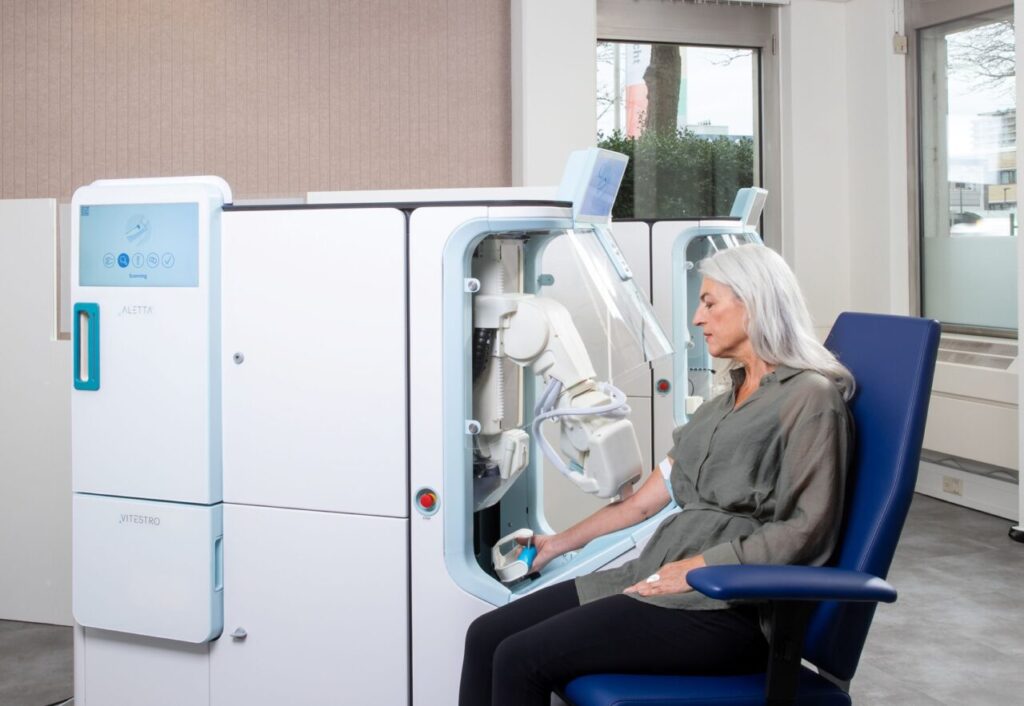
Viewed in isolation, it’s simply another technological advancement. Viewed alongside everything else that’s happening, it becomes part of a much larger story.
This opens the door for AI and robotics to encroach even on procedural parts of medicine.
Thinking Like a Physician vs Thinking Like a Patient
Whenever these conversations come up, I try to think about them from both sides of the exam table:
As physicians, it’s natural to fear how technology might reshape our profession.
As patients, the questions are different, and perhaps more exciting.
If one of my boys woke up in the middle of the night with a fever and a rash fifteen years from now, what do I hope will be available to him?
Imagine if he could immediately access an AI physician for a nominal fee that has been trained on millions of pages of medical knowledge? Even better if it’s from the comfort of his own home, rather than a cold exam room in an overcrowded ER at 3AM.
That doesn’t diminish the value of physicians. But it’s certainly a different world of medical care than exists today.
How will physicians exist and hopefully thrive in this new world? We are going to find out, and soon.
When AI Is Better than a Physician
Before I close, I want to leave you with yet another question that I think about often:
What happens when the diagnostic power of AI is demonstrably and unquestionably better than most physicians?
It’s one thing when a certain tool or service is equal in skill to a physician (or non-inferior, as we like to say). But what happens when AI is indisputably better than the vast majority of physicians at diagnosing illness?
I would argue that we’ve already crossed this Rubicon when it comes to AI’s ability to write human text: term papers, marketing copy, speeches, etc. AI is markedly better than most writers already.
Similarly, we will also soon face a future where study after study confirms that AI is better than your average physician at taking all available data, integrating it into the clinical scenario, and coming to the right diagnosis.
When this happens in the next few years, is it possible that hospitals and doctors will face liability for not using AI diagnosticians?
Looking Ahead
If I were applying to medical school today, I would make the same choice. Medicine continues to challenge me intellectually and gives me the privilege of making a meaningful difference in people’s lives.
It’s also still the flexible profession that allows me to continue to care for patients part time, even as I pursue business with the majority of my time.
What I would probably do differently is spend more time thinking about the physician I might become fifteen or twenty years from now in the age of Alternative AI in Medicine, rather than assuming the profession will evolve at the pace it always has.
That isn’t a reason to avoid medicine. If anything, it’s a reason to approach it with curiosity. Medicine will always need physicians, but every generation of physicians inherits a different version of the profession. Ours may simply be arriving at a moment when those changes are happening more quickly than we’re accustomed to seeing.
For now, I think it’s enough to recognize that the transition has already begun. AI isn’t waiting for medicine to decide whether it’s ready. It’s quickly becoming a key part of the way healthcare is practiced, one workflow, one clinic, and one hospital at a time.

Sources
- NEJM AI. https://ai.nejm.org
- Stanford Institute for Human-Centered Artificial Intelligence (HAI), AI Index Report. https://hai.stanford.edu/ai-index-report
Want to support the blog?
- Join our investor club at Cereus Real Estate
- Visit my Recommendations page
- Check out my wife’s food blog: Eat Dessert First
- Check out my TikTok channel
- Follow me on Instagram
- Follow me on YouTube
- Contact me with questions
Experience the financial benefits of real estate without dealing with the headache!